
How to Search New Roads Court Docket
New Roads runs no municipal docket portal you can count on. So start with the paper. A district civil, criminal, family, or succession case lives in the Pointe Coupee Parish Clerk of Court system. It sits under the 18th Judicial District Court. Smaller matters work differently. An eviction, a small claim, or an ordinance case may not reach the district at all. It may sit with one of the parish Justice of the Peace offices instead. For a city citation, read the citation itself. The court and agency printed on it tell you where the case belongs. Guessing City Hall handles it is the one mistake to avoid.
- Read the citation, summons, notice, or case paper for the court name, case or citation number, and appearance date.
- For an 18th JDC matter, use ClerkNet or contact the Pointe Coupee Parish Clerk of Court with the known identifier and case details.
- For a small civil claim, eviction, ordinance, or certain limited criminal matter, use the Justice of the Peace directory to identify the correct district.
- If the ticket names a city or another lower court, call that issuing authority. No official New Roads court search or payment form was located.
- Confirm a hearing setting with the court that keeps the file before appearing. A result in one system does not establish the schedule in another.
ClerkNet's public landing page shows Email and Password fields plus account-setup controls. What appears after login stays behind that wall. A name-only search, or a filter narrowed to New Roads cases, may or may not exist there, so plan for other ways to pin down a case number.
No New Roads Court Docket Portal
New Roads' official civic site covers city administration, council materials, events, contacts, and bill-pay links. No municipal-court docket appears anywhere on it. There is no citation lookup or fine schedule. There is no Mayor's Court page and no traffic-payment portal. That gap matters. New Roads City Hall is an administrative office, not a court-records desk. Treating it as one wastes a trip.
Where does a New Roads citation actually go? Possibly a Mayor's Court, a JP office, the 18th JDC, or another venue entirely. The citation is the first reliable clue. If you have lost it, ask the issuing agency or City Hall which court now handles the case. Do not infer jurisdiction from the city's name.
New Roads route. No located city portal means the citation or case paper, not a general city search, identifies the custodian.
New Roads Municipal Court Status
The city names no New Roads municipal court. Nothing official lists a judge or a court building. Nothing lists a public docket, a citation search, a fine schedule, or a payment vendor for one. Calling New Roads a court with a local online docket would simply be wrong. Being the parish seat changes none of that.
Cases touching New Roads residents and events land in the 18th JDC or a JP court. Some go to whatever lower court the issuing agency picks. The 18th JDC holds original civil and criminal jurisdiction. That reach spans Pointe Coupee, Iberville, and West Baton Rouge Parishes. The Clerk of Court keeps the district-court records for Pointe Coupee Parish. They cover civil, criminal, family, succession, and related filings. JP offices maintain their own limited-jurisdiction files separately.
New Roads City Hall and Courthouse
Addresses in New Roads can trip you up. City Hall sits at 211 West Main Street. Two blocks away, at 201 East Main Street, you will find the 18th JDC and the Pointe Coupee Clerk of Court. That office keeps the district-court records. A third stop, 160 East Main Street, Suite A, houses the parish-government office that publishes JP guidance. Each building does its own job. City Hall handles municipal administration. The Clerk's office is where a Pointe Coupee court docket request actually lands. For a sense of how the city presents itself, the New Roads City Hall site carries the municipal orientation information. The official page it leads to shows the city's own departments and contacts.

Keep civic business and court records separate in your head. A New Roads mailing address alone tells you nothing about which office holds a file. So name the court in your request, plus the case or citation number, the record type, and the date range you need.
New Roads Court Dates and Settings
One calendar warning deserves attention. The 18th JDC printable calendar covers district-court business, not a New Roads municipal schedule. Its own notice says the public calendar lists criminal court dates and civil rule dates. It also warns that settings change. It does not reflect frequently shifting civil hearings or civil trial dates. Here is the trap. A New Roads date printed on a citation can belong to a different court entirely. Compare the citation with the court record before you rely on the district calendar.
| Court named on paper | Use the court or issuing authority on the citation, summons, or filing to choose the correct New Roads route. |
|---|---|
| District calendar category | The 18th JDC publishes criminal dates and civil rule dates, not a complete New Roads calendar. |
| Case or citation identifier | Keep it exactly as printed. Pointe Coupee has not published a local case-number format. |
| Date and setting | A current docket or clerk-held file may show the event history; confirm a changing setting directly. |
| Courtroom or judge | Not confirmed as a standard New Roads public-calendar field. Ask the responsible court. |
Chasing an 18th JDC case? The Pointe Coupee court-calendar route walks through that published calendar warning and the ways to confirm which division has your hearing.
New Roads Court Date Confirmation
Confirming a hearing date in New Roads starts with whichever office holds the case. For an 18th JDC matter, pull up the official printable calendar. Look there for your criminal or civil-rule setting. That calendar names three confirmation routes: the judge's office, the parish Clerk, and the District Attorney. Then call the right number. Division A publishes 225-638-5532, Division B publishes 225-336-2419, and the Pointe Coupee Clerk publishes 225-638-9596. A quick call also lets you cross-check the clerk-held file against what the ClerkNet record shows.
A city citation or lower-court matter works differently, because the issuing court sets the date. Do not rely on the City Hall civic calendar or its council agendas for this. Those list city events, not hearings. They will not confirm an arraignment, trial, or any other court disposition.
Note: A civil hearing or trial date can shift without ever appearing in the public district calendar. Call the court directly to confirm.
New Roads Traffic Tickets
New Roads runs no citation-number lookup or traffic-payment portal. So the paper ticket itself is the starting point. Read the issuing agency and the court printed on it. A parish sheriff or state-police citation may land in the 18th JDC or a JP venue. A city-issued citation needs confirmation from the issuing authority, since the city's official site stays silent on where such tickets are docketed.
The Louisiana Charge Code System offers one workaround. It looks up charge and cost details by court, offense date, and charge or statute. But it cannot search a ticket number. It shows no case status or court date. For the docket, the appearance date, payment method, or how to contest, the proper court remains the only real source.
New Roads Citation Venue
The city name printed on a ticket proves nothing about the court. Begin instead with the citation number. Check the issuing officer or agency, the court caption, and whatever appearance instruction the paper carries. A ticket naming a JP belongs at that JP office, found through the parish directory. One naming the 18th JDC follows the ClerkNet and Clerk route. If it names a city court or a Mayor's Court, ask that office directly. Ask about its calendar and record process.
Pointe Coupee has twelve JP districts. They handle limited civil matters up to $5,000, evictions, ordinance violations, and certain criminal matters. The right district turns on venue and case type, not a New Roads mailing address. No rule sends every New Roads citation to one JP office.
Where New Roads Cases End Up
Jurisdiction decides where a New Roads case lands, not geography. Felonies, general civil suits, family matters, and successions filed in Pointe Coupee all run through the 18th JDC and its Clerk. A JP file stays with that JP office unless an appeal or later proceeding creates a new record. A city or lower-court citation starts with the issuer's court, even if the ticketed person lives in New Roads or the traffic stop happened a block from the courthouse.
Docket flow: New Roads issuing authority, if a city ticket, › exact Mayor’s Court or JP named on the citation › 18th JDC and Pointe Coupee Clerk for district matters › Louisiana Court of Appeal, First Circuit for qualifying appeals.
The First Circuit hears appeals from the 18th JDC. Which route applies depends on the court and the case type, so confirm the issuing venue before treating any appeal as a district docket. For a known 18th JDC case, the county-level court record is still the better starting point.
New Roads Older Court Records
New Roads is the courthouse hub. Yet the ClerkNet civil index reaches back only to November 4, 1991. That cutoff is not proof an older record never existed. Historical civil suits, probate material, and older files may sit in paper archives. They may also require a clerk-assisted search or a mailed request. The clerk can also sort out what you actually need. A docket, minutes, a filed document, a judgment, a certified copy, and a transcript are different products. The parish contact page serves parish government generally, not district-court records.
That parish contact route works for general parish questions and JP context. For a district court record, direct the request to the Clerk, name the court and the item sought, and confirm the current copy fee before paying.
Public Access to New Roads Court Records
Louisiana public-record law allows inspection and copying of public records unless a specific exception applies. For a New Roads district matter, the Pointe Coupee Clerk holds the file. A JP or town court keeps its own. One caution: a public calendar or docket index is not the same thing as a complete case file, a certified copy, or a transcript. Ask for the precise record you need. Ask whether it is public, restricted, or carries a copy charge.
Key rules.
La. R.S. 44:1 defines public records, including electronic information and databases, subject to exceptions.
La. R.S. 44:31 recognizes a qualified right to inspect and copy public records unless an exception applies.
La. R.S. 44:32 addresses the custodian’s process for presenting records and providing copies.
Juvenile, child-protection, sealed, expunged, and protected records stay restricted. A New Roads search that turns up nothing can mean the wrong court, an older record, a confidential case, or an online coverage gap. It does not mean no file exists.
New Roads Courthouse Access
Both court offices sit in New Roads. The 18th JDC handles district-court matters. City Hall runs the municipal side as a separate office. Before you reach a courtroom at the courthouse, plan on a security screening. The court's security rules ban phones, cameras, recording gear, weapons, sharp tools, aerosols, food, drinks, and gum. No locker policy is posted. The court lists no public terminals or city-court building for New Roads.
Need a word-for-word record instead of the docket minutes? The 18th JDC transcript-request page spells out that difference. It routes a transcript request to the certified court reporter.
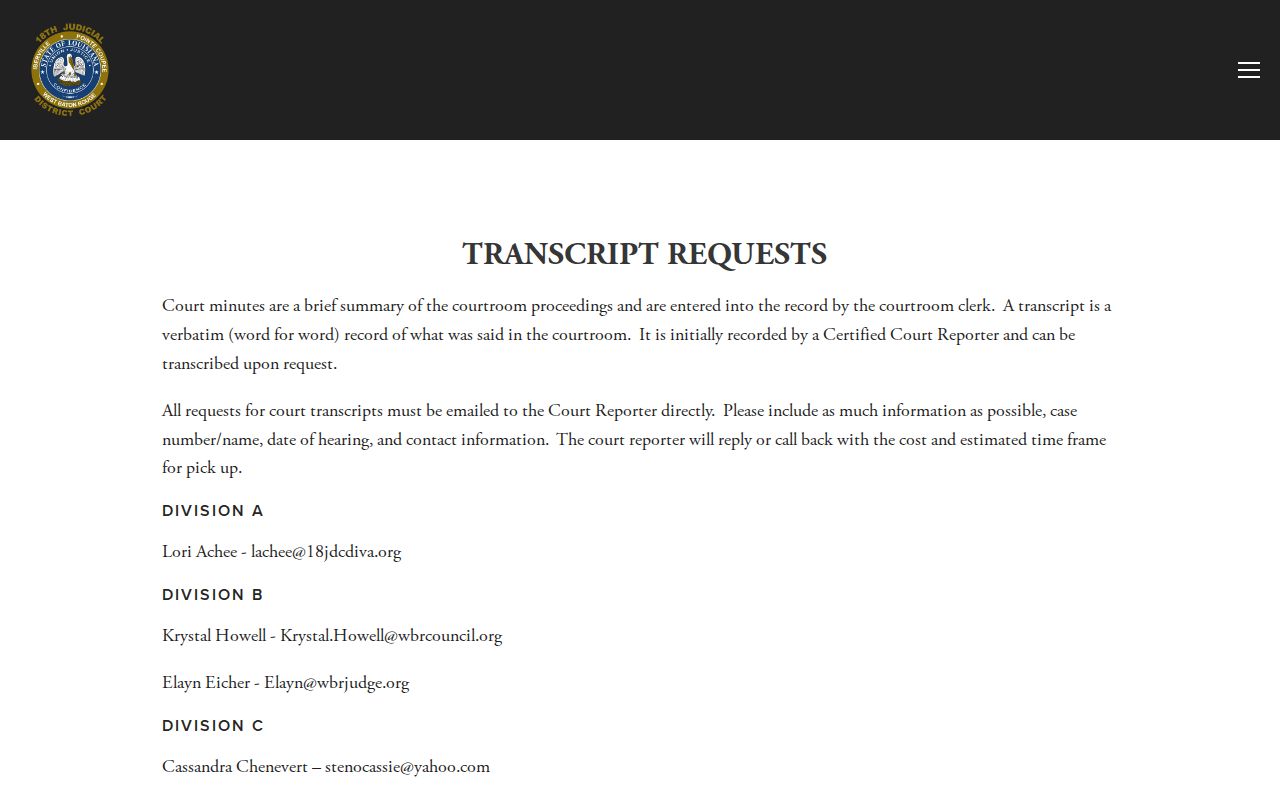
Minutes are short summaries the courtroom clerk enters. A transcript is a different product, so a New Roads requester should give the assigned reporter the case name or number, the hearing date, and contact information.