
How to Search Pointe Coupee Criminal Dockets
Felony and general criminal records in the parish begin with the Pointe Coupee Parish Clerk of Court. That office serves as district-record keeper for the 18th Judicial District Court. The clerk also backs the ClerkNet portal. It advertises cases, dockets, minutes, document purchases, and criminal e-filing. One catch: the public landing screen requires an account. No criminal case-search form sits out in the open. The fields you get after signing in stay behind the login. So a subscription or e-filing notice does not guarantee that every docket, minute entry, or image is viewable online.
Gather the defendant's full name, a likely filing year, and any case number you already have. Then confirm which court holds the matter. The clerk can verify current criminal index coverage, the local case-number format, access to older files, and document prices at 225-638-9596. When ClerkNet fails to return a result, the counter, phone, email, fax, or mail route is the practical next step.
- Open ClerkNet and establish the account access it requires for Pointe Coupee cases, dockets, and minutes.
- Search with the best available name and filing-year details, then preserve the exact case number and division if a match appears.
- Read the chronological docket or minutes for settings and entries rather than inferring an outcome from a single date.
- Check the court calendar for a current criminal date, then confirm a changing setting with the clerk, judge’s office, or district attorney.
- Ask the Pointe Coupee clerk for a plain or certified copy only after identifying the document title and date needed.
Note: ClerkNet's public page lists the product categories only; it does not spell out the full post-login criminal field list or image coverage.
Pointe Coupee Felony Criminal Docket Route
The 18th Judicial District Court holds original civil and criminal jurisdiction over Pointe Coupee, Iberville, and West Baton Rouge Parishes. For a Pointe Coupee felony criminal docket, that court plus the parish clerk are the main route. The court runs four elected divisions. ClerkNet keeps its details behind account access. So ask for the assigned division rather than guessing from a party name or courthouse location.
Statewide, the Louisiana Clerks' Remote Access Authority supplies clerk technology. But LCRAA/eClerks LA does not operate as a universal public trial-docket index. Louisiana law directs district clerks to support electronic filing, recording, and remote access through that system. Even so, the working front door for Pointe Coupee criminal docket research stays with ClerkNet and the clerk's office.
The 18th JDC security rules show the screening devices and restricted items visitors encounter at the courthouse. 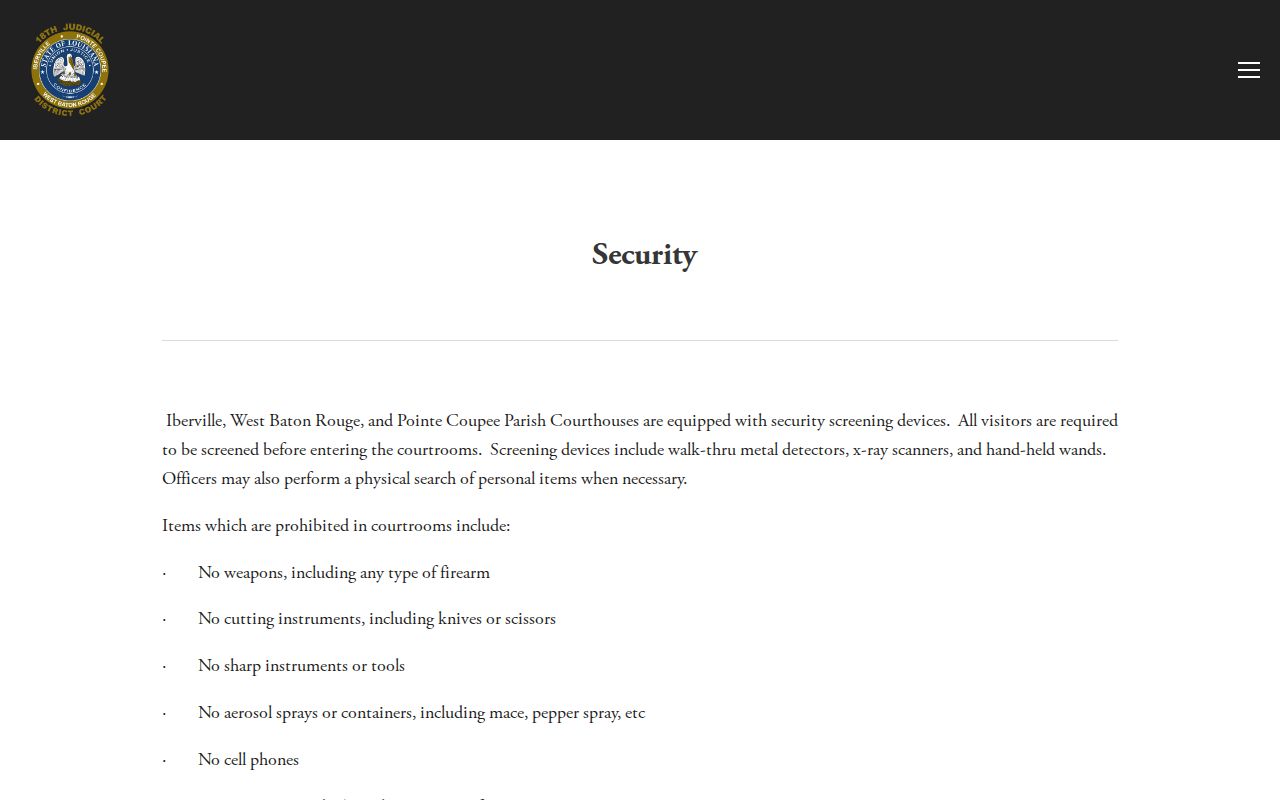 Court access can be needed when a local criminal record or paper file is not available from the account-based portal.
What a Criminal Docket Shows
Think of a Pointe Coupee criminal docket as a chronological register, not one tidy conclusion about a case. A reader doing a case lookup might look for the case number, filing date, court and division, judge, State and defendant roles, charging event, settings, motions, orders, plea or verdict, disposition, sentence, appeal, and any redacted or sealed marker. ClerkNet offers cases, dockets, and minutes as products, but which fields appear after a local login is not something the public page spells out.
| Case number | Use the exact number ClerkNet or the Pointe Coupee clerk provides. No local criminal number format was confirmed, so do not invent a CR pattern. |
|---|---|
| Charging event | A complaint, bill of information, or indictment may mark the start; verify the actual Pointe Coupee event label with the clerk. |
| Settings and minutes | Look for arraignment, appearance, pretrial, motion, plea, trial, or disposition activity in date order. |
| Orders and documents | A docket entry can identify a filing even when the image is purchased, restricted, or unavailable through the portal. |
| Outcome | Use the recorded plea, verdict, dismissal, acquittal, sentence, or other disposition entry, not a hearing date alone. |
Pointe Coupee Criminal Docket Calendar Limits
The official 18th JDC printable calendar posts both criminal dates and civil rule dates. That helps a Pointe Coupee criminal docket search when a hearing is close. Still, it cannot replace the case record itself. The court warns that dates change. It tells readers to confirm with the judge's office, clerk, or district attorney. A calendar date may just be a setting. The docket and minutes give the filings and rulings around it.
Before calling, write down the case number, division, setting date, and your question. Division A's page lists the Pointe Coupee office at 201 E. Main Street and 225-638-5532. For the record itself, the clerk is still the better first contact. When a hearing was taken down word for word, the court's transcript route asks you to email the court reporter with the case number or name, hearing date, and contact details. A transcript is not the minutes, and the minutes are not the docket.
Stages on a Criminal Docket
A Pointe Coupee criminal case can open with a complaint, bill of information, or indictment. The exact local label varies. Later entries may cover first appearance or arraignment, bond or release conditions, pretrial motions and settings, a plea or trial, and disposition or sentencing. If an appeal notice or post-disposition motion follows, the Louisiana Court of Appeal, First Circuit takes over. It keeps its own separate record.
Docket flow: Charging event › Arraignment or appearance › Pretrial settings and motions › Plea or trial › Disposition › Sentencing or appeal.
Read terms like bond, capias, nolle prosequi, deferred, or continuance with care. The parish publishes no code sheet, so generic abbreviations such as DISM or CONV should not be treated as confirmed local codes. Ask the clerk to explain any abbreviation before you rely on it.
Pointe Coupee Criminal Drug Court Docket Access
The 18th JDC's Pointe Coupee Drug Court runs as a court-supervised rehabilitation and supervision program for eligible adult felony offenders dealing with substance abuse or addiction. Its official page names Judge J. Kevin Kimball, Division A, and lays out a minimum 18-month program with four phases, outpatient groups, support meetings, random drug screens at least twice weekly, and bi-weekly status hearings. Those details describe how the program works. They do not promise that a separate public drug-court docket number exists.
The official Pointe Coupee Drug Court page is the source for the program description. 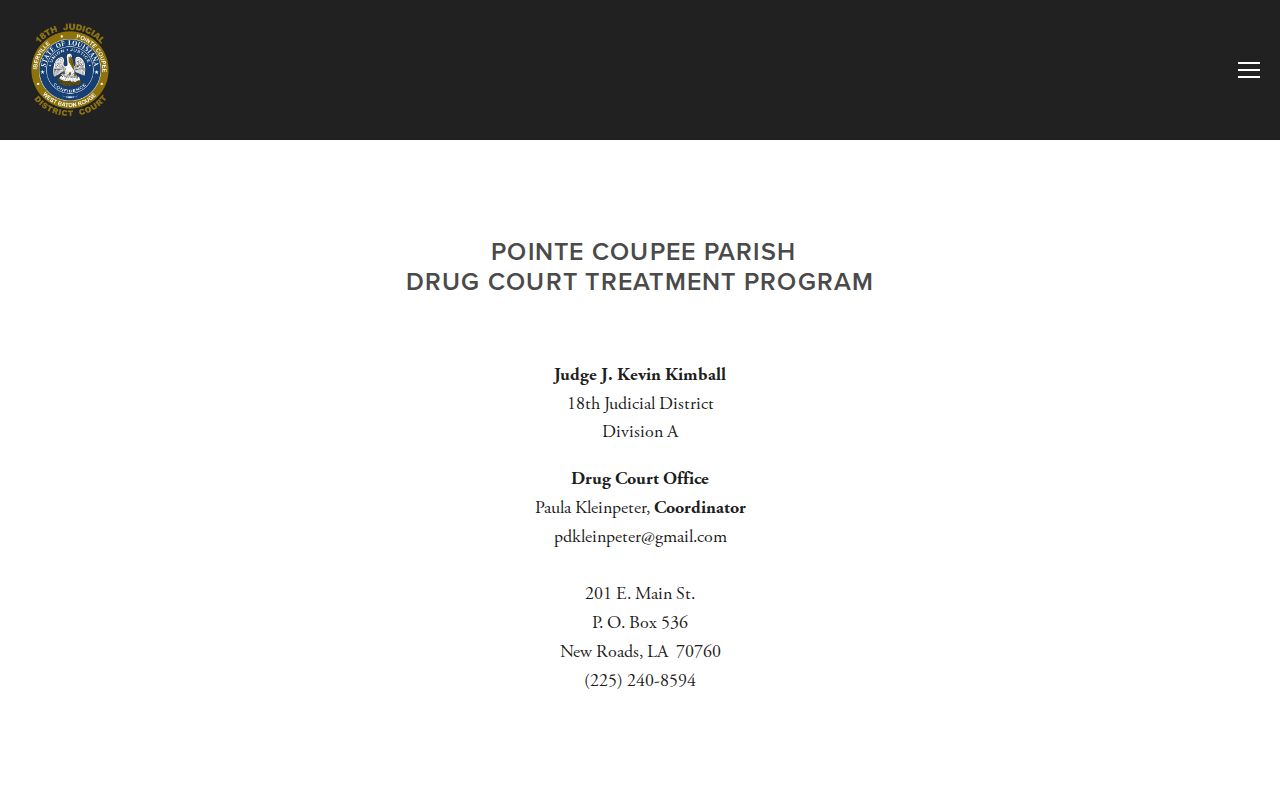 A participant’s underlying criminal matter and any public status information must be confirmed through the right clerk or court channel, particularly when ClerkNet access has not revealed a specialized docket view.
Which Court Holds Criminal Dockets
Where does a Pointe Coupee criminal docket actually live? It depends on the charge. Felonies and general criminal matters go to the 18th JDC. The parish clerk keeps those records. Misdemeanors, DWI, traffic tickets, ordinance violations, and limited criminal matters may sit instead in a Justice of the Peace court or a Mayor's Court in an incorporated municipality. A traffic footnote in the 2025 state report backs this up. It notes that parish, city, and juvenile or family courts all process these cases. So the first question in any docket search is which court took the charge.
| Likely Pointe Coupee venue | Criminal docket route |
|---|---|
| 18th JDC felony or general criminal matter | ClerkNet, then the Pointe Coupee Parish Clerk of Court at 201 E. Main Street, New Roads. |
| Justice of the Peace matter | Match the venue to the correct one of twelve JP districts and contact that office directly. |
| Fordoche or Livonia town matter | Use the town court’s own procedure, payment, or date-contact route rather than assuming it appears in the district record. |
Pointe Coupee Criminal Docket Filing Context
The Louisiana Supreme Court's 2025 Annual Report covers all of Louisiana. Its 18th JDC statistical table puts criminal filings for Pointe Coupee at 672. That number counts filings, nothing more. It is not a count of people, active cases, or convictions. Nor does it promise anything about the next court date. The report also lists parish rows separately. A district total spans Pointe Coupee, Iberville, and West Baton Rouge. Keep that scale in mind. A Pointe Coupee criminal docket is only one slice of the three-parish district workload.
That 233-day figure is a reporting measure. It is not a deadline for any individual case. It also says nothing about how fast you might receive a copy. Docket activity varies, continuances happen, and lower-court routes differ. The annual report lists one criminal jury trial for the year, and that single count tells you nothing about pleas, bench trials, dismissals, or other dispositions.
Pointe Coupee Criminal Docket Documents
A docket entry and the document behind it are two different things in Pointe Coupee. ClerkNet advertises document purchases with print or PDF options. Its public page posts no price list, though. It also does not confirm that every filing image is online. When the register shows a motion, order, minute, or other event but the image is missing, give the clerk the case number. Add the document title or event and the date. Say whether you need a plain or certified copy too. The clerk can then walk you through delivery, payment, archive retrieval, and certification.
Want a word-for-word hearing record? Use the court reporter process instead of a docket-copy request. For a lower-court matter, contact the JP or town court that keeps the file. A general parish public-record request is worth considering only if the clerk sends you there. It does not replace a clerk-certified court-copy request. The clerk posts no official certified-copy, per-page, docket-sheet, or document-image fee. Confirm current fees before you pay. Note: A ClerkNet subscription provides access options. But a subscription alone does not grant a certified record.
Public Access and Sealed Criminal Dockets
Louisiana public-records law backs inspection and copying of public records. It allows exceptions and reasonable clerk procedures. In Pointe Coupee, start with the local clerk. A public docket index does not automatically show every filing or lift a restriction. A no-result search can point to the wrong court, a spelling slip, or the wrong year. It can also reflect an access layer or a confidential, sealed, or expunged matter. It never proves the case does not exist.
Key rules for Pointe Coupee criminal docket access:
La. R.S. 44:31 recognizes the right to inspect, copy, or reproduce public records unless an exception applies.
La. R.S. 44:32 addresses the custodian’s duty to present records and reasonable copy procedures and fees.
Children’s Code art. 412 makes juvenile records and reports confidential except as the statute authorizes.
Children’s Code art. 1007 protects specified child-protection records and proceedings.
Pointe Coupee Juvenile Criminal Docket Access
Juvenile records add another access layer. A juvenile matter may not show up in a public Pointe Coupee criminal docket view at all. Only the disclosures the law expressly permits come through. The same caution covers child-protection records. It also covers the 18th JDC Families In Need of Services process. FINS serves Pointe Coupee, Iberville, and West Baton Rouge. It works through referrals and services meant to keep kids out of formal juvenile court. Treat it as its own process, not an ordinary public adult criminal docket.
The 18th JDC FINS page describes the program and its community-service approach. 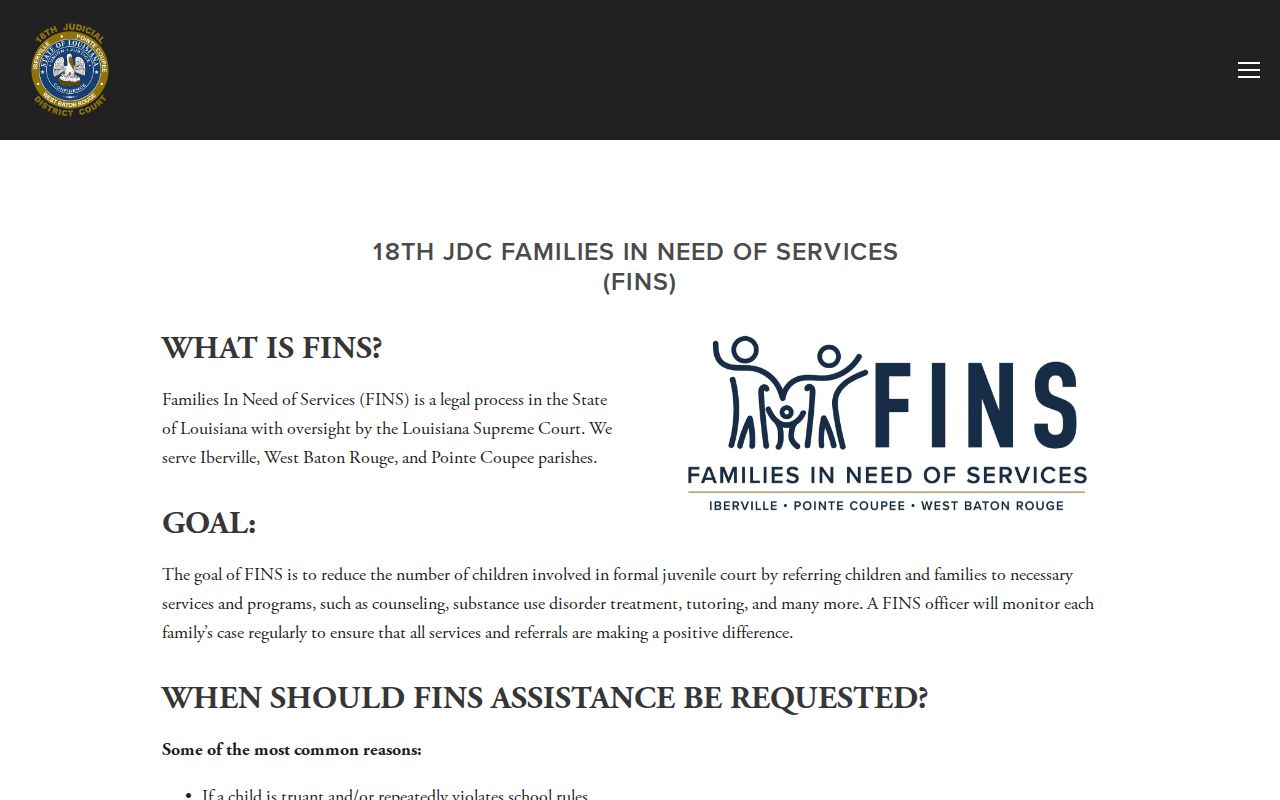 The public description does not authorize disclosure of individual FINS or juvenile records.
Louisiana Children’s Code art. 412 is the official source for juvenile confidentiality. 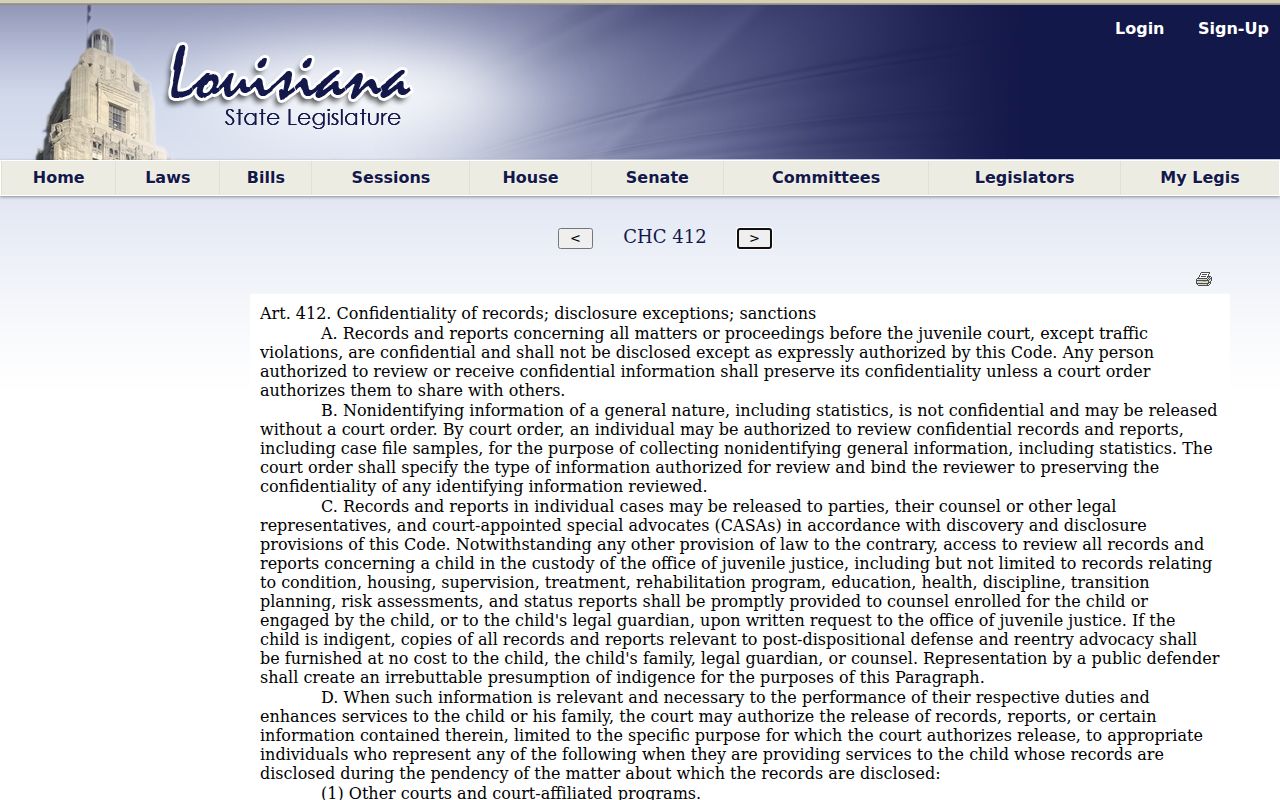 Sealed or expunged records can also disappear from ordinary search; any request for access must follow the applicable statute or court order.